
Are you about to get a new car (whether dealership or pre-owned) and suddenly they ask you a technical question that sounds like hieroglyphs, but goes straight to your pocket? This is the big question: Does this engine move with a chain or a timing belt?
At first glance, it seems like a minor detail. In the end, the car turns on and does its job of taking you everywhere. However, overlooking this information is a textbook financial error. Making the wrong decision—or worse, neglecting to maintain that system—can walk the fine line between a routine service that costs a couple of bucks or a nightmarish breakdown that forces you to rebuild half an engine.
In this report updated to 2026, we are going to explain to you bluntly what separates the chain from the leash, how much it will really cost you to maintain them in Latin America and which of the two fits best with your lifestyle and your budget.
What is the distribution chain and why do many prefer it?
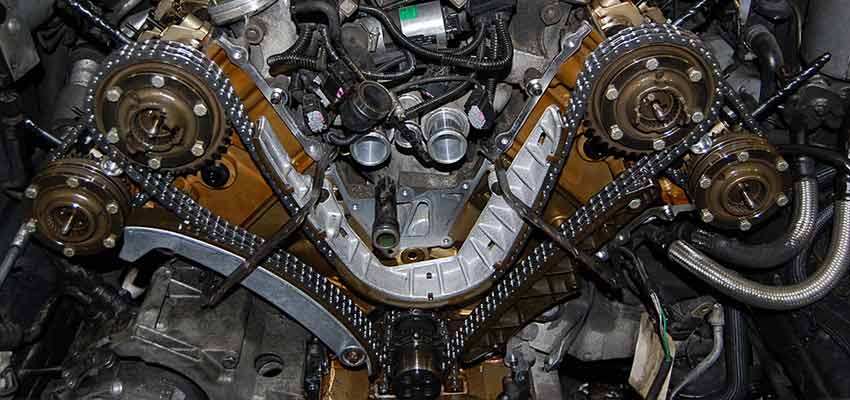
Imagine a bicycle chain, but taken to a heavy-duty industrial level. It is forged from metal alloys designed for heavy work. Its mission is vital: it acts as the orchestra conductor that synchronizes the crankshaft with the camshaft, making the engine valves dance at the precise rhythm.
Its inner workings
Being a metal piece that lives bathed in the same engine oil, it has enviable resistance. It is made to withstand pressure without deforming or breaking under normal conditions. By working in a sealed and lubricated environment, you stay safe from outside dust and debris.
The good thing about choosing chain
Resistance to everything: In an ideal world, it should accompany you for the entire life of the engine (we are talking about 250,000 km or even much more).
You forget the calendar: You don’t have to count the months to go to the workshop as happens with the strap; Its maintenance is minimal.
Peace of mind behind the wheel: It is extremely unusual for it to break out of nowhere without giving any prior signs.
The weak points
Own soundtrack: With the passage of time and use, they tend to become somewhat noisy (that characteristic metallic “rattle”).
Major surgery: If it fails—usually due to the tensioners or guides—the intervention is much more in-depth and expensive than a simple belt change.
What an intervention would cost you
Although technically it is said that “it lasts forever”, the reality is that key parts such as tensioners or plastic guides do suffer from fatigue and require your attention to avoid major disasters. In terms of investment, you must calculate a general expense of between $400 and $800 USD (including spare parts and labor), a figure that usually fluctuates depending on whether you are in Mexico, Colombia or the Southern Cone.
On the other hand, if you lean towards high-end vehicles or premium brands such as BMW or Audi, this budget changes radically. Due to the complexity of their engine design and the cost of the original components, be prepared for that bill to be duplicate easily when passing by the workshop.
What is the timing belt? (The silent option)
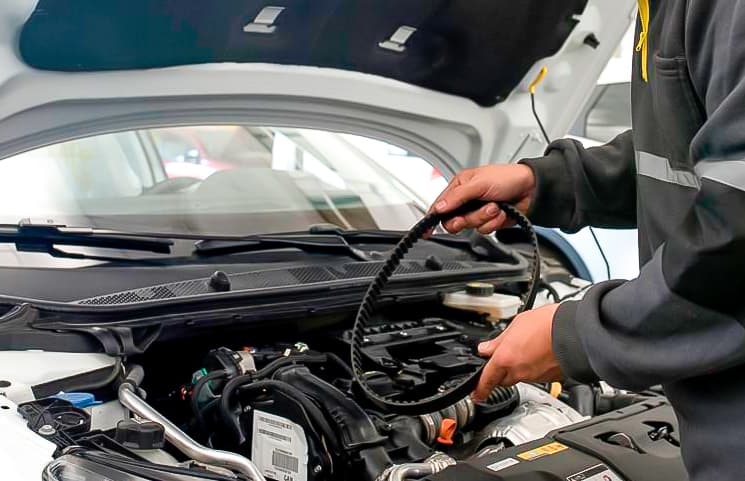
The strap is basically a highly engineered elastic band reinforced with synthetic materials such as Kevlar or fiberglass. Although it fulfills exactly the same synchronization mission as the chain, it does so under a completely different design philosophy, prioritizing lightness.
Its inner workings
Unlike its metallic sister, this piece works “dry” (outside of the engine oil, although protected by plastic covers) and transmits rotation through a system of teeth that fit together perfectly. It is, by far, the most common solution in the compact cars and medium-sized models that we see driving daily.
The good thing about choosing a strap
Running silence: Being made of a flexible material, the engine sounds much more refined and smooth.
Initial savings: It helps make the sales price of the car a little more competitive from the agency.
Mechanical efficiency: Being lightweight, it generates less internal resistance, which allows the engine to make better use of each horsepower.
The weak points
Scheduled expiration: There is no doubt here; It is a component that is going to be spent. You have to replace it no matter what, following what the manual dictates, normally every 60,000 or 90,000 kilometers (or every 5 years, whichever comes first).
Silent risk: If you decide to “stretch” its useful life more than necessary, it can burst at any moment without you hearing a single prior noise, leaving the engine out of action.
Approximate preventive maintenance costs
Changing the belt is not a repair, but a fundamental part of regular maintenance of your vehicle. On average, the investment ranges between $150 and $400 USD for the complete kit (which usually includes tensioners and the water pump). It is an expense that you already know is coming, but that is mandatory to sleep peacefully.
Comparison: Chain vs Belt
When choosing your next car or planning your visits to the workshop, understanding what’s under the hood is vital. It’s not just mechanics; It is a financial decision. Both the chain and the belt have the same critical mission: to make the crankshaft and camshafts dance in perfect synchronization so that the engine is not destroyed.
The distribution chain: Long-term resistance
If you want to forget about the workshop for a long time, the chain is the protagonist. Its greatest virtue is longevity, as it is manufactured to accompany the engine throughout its useful life, as long as you do not skimp on the quality of the oil.
Unlike other components, it does not require frequent visits; Its maintenance is almost symbolic and is reduced to checking the tensioners when the odometer already shows very high figures. Although over the years it can become a little noisy, it gives you enormous peace of mind: it is extremely difficult for it to break out of nowhere. Of course, if you neglect lubrication and it fails, the mechanic’s bill will be a heavy blow to your pocket.
The timing belt: Smoothness and commitment
On the other side we have the belt, which stands out for offering a much quieter and more refined operation, avoiding metallic friction of the chain. However, this comfort comes with one condition: a total commitment to the calendar.
Being made of rubber and synthetic fibers, its replacement is mandatory and does not allow extensions, generally every 60,000 or 90,000 kilometers (or after 5 years). This translates into a periodic expense that you must include in your annual budget. You cannot ignore it, since if the belt decides to say “enough” due to lack of maintenance, the internal disaster in the engine will be total and the repair will cost you a small fortune.
What happens if each one breaks? (mechanical consequences)
This is where budget meets panic, and believe me it makes sense.
Whether your motor uses a chain or belt, if this system fails while you are driving, the internal choreography is instantly broken. The pistons will not stop going up and down due to inertia, but the valves will remain static in the worst possible place.
The result is a brutal crash: the pistons end up hitting the valves, bending them or directly pulverizing them. In the vast majority of current engines (the so-called “interference”), this oversight results in mechanical carnage. We are not talking about a simple adjustment, but about opening the engine to rectify the cylinder head, replace valves and, in the darkest scenarios, having to change the entire block because the damage is irreparable.
The crucial difference for your peace of mind is how they warn you. The strap is treacherous; It usually breaks silently and without warning. On the other hand, the chain is a little more “scandalous”: before giving up, it usually gives you a very particular metallic rattle, giving you that vital margin of maneuver to get to the workshop before disaster strikes.
What is best in 2026?
The answer to which system is superior depends entirely on your lifestyle and how you take care of your investment:
1. For those looking for a used car with a measured budget
If you are looking at a second-hand car with more than 100,000 km and you don’t want surprises, be careful with the chain. If the previous owner was sloppy with oil changes, that chain could be stretched and will cost you a fortune to replace. In this scenario, sometimes it is smarter to buy a car with a belt, negotiate a reduction in price and change the complete kit yourself. Thus, you ensure peace of mind for the next 60,000 km without spending more.
2. For mile-eaters (Uber, travel or work)
If your plan is to ride about 30,000 km a year, the distribution chain is your best ally. You eliminate the hassle of visiting the workshop every year and a half just to change the belt. Of course, the deal is simple: you have to be disciplined and “religious” with the use of top quality synthetic oil so that the system never suffers.
3. If you go for a 0km in 2026
The industry is strongly returning to the chain or betting on modern “oil-soaked belts” that promise a much longer life. If you are new to your car this year, choosing one with a chain is usually a masterstroke, as it maintains a better resale value; The next owner will appreciate not having to invest in that major maintenance anytime soon.
The final verdict
There is no absolute winner, but there is a golden rule that will save you a lot of headaches:
If your car uses a belt: Consider the change date as a sacred appointment that cannot be postponed.
If your car uses a chain: Never, under any circumstances, save a few cents by lowering the quality of the oil.
Being clear about this difference before closing the deal can be the difference between enjoying your route or facing the most bitter bill a driver can receive.
Frequently Asked Questions (FAQ)
How do I know if my car has a chain or belt?
The most foolproof way is to consult the manual or ask your trusted workshop. But if you want to play detective, open the hood: if you see a plastic cap on the side of the engine, it is most likely a belt. If the cover is metallic, it is sealed and it is part of the engine block, you have a chain.
How much does it cost to change the timing belt in 2026?
Although the price varies depending on the country and model, in Latin America the average ranges between $200 and $450 USD. Be careful, this budget usually includes the complete “distribution kit” and the water pump, something that must be changed at the same time to avoid double work.
Are distribution chains eternal?
Almost, but no. They are designed to last as long as the engine, but they are not magic. The tensioners and guides (which are usually made of high-resistance plastic materials) do get tired. After 200,000 km, it is vital that your mechanic keep an eye on them to prevent the chain from loosening.
What happens if the belt cuts while I’m driving?
The engine will shut down instantly as if the breath has been taken away from you. Golden rule: If you suspect that the belt broke, don’t try to start the car again. Every time you turn the key in this state, the pistons hit the valves with more force, transforming a serious problem into a total destruction of the engine.
Editorial by Gossipvehicle